
Building and Scaling AI for Social Impact and Public Interest AI
Event Highlights
Kalpa Impact and The Rockefeller Foundation brought together industry leaders for the release of the working report Opening Up Computational Resources for New AI Futures, and a panel discussion, at the India AI Impact Summit 2026.
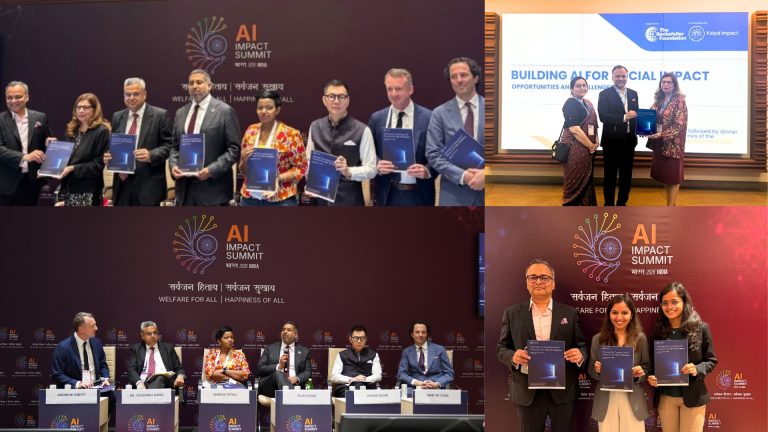
The event, titled “Building Public Interest AI: Catalytic Funding for Equitable Access to Compute Resources”, was a key event held at the India AI Impact Summit 2026, at Bharat Mandapam, on 20 February.
The event included the release of a working report, and a discussion centred on a critical question: How do we move from talking about AI resources to building alternate, public-interest AI infrastructure?
The event, hosted by Sushant Kumar – Founder and CEO, Kalpa Impact, featured a keynote by Dr. Saurabh Garg – Secretary, MoSPI, Government of India, opening remarks from Deepali Khanna – Senior Vice President and Head of Asia, and a panel moderated by Andrew Sweet – Vice President, Innovation, The Rockefeller Foundation, with Martin Tisné – Founder and Chair of the board, Current AI, Vilas Dhar – President, Patrick J. McGovern Foundation, Shaun Seow – CEO, Philanthropy Asia Alliance, and Dr. Shikoh Gitau – CEO, Qhala.
This esteemed panel of speakers also released the working report, titled “Opening Up Computational Resources for New AI Futures”, written by Jai Vipra, Sushant Kumar, and Pranjal Kothawade.
Keynote
In his keynote, Dr. Garg emphasised that the fundamental question is not whether AI will transform the world, but whether that transformation will be equitable, inclusive, and aligned with public interest. He also noted that countries are actively seeking agency in AI.
He outlined six foundational pillars: Compute, Capability, Collaboration, Connectivity, Compliance, and Context, and introduced the MAITRI platform (Multi-stakeholder AI for Trusted and Resilient Infrastructure), a collaborative digital public good designed to expand access to compute, data, and partnerships through a voluntary, modular approach.
Panel Discussion: Key Themes
A consistent thread through the panel was that compute alone is not enough, and may even be overrated as a focus area. Martin Tisné warned that data centres risk becoming white elephants without contextual data, local languages, and a resourced open-source ecosystem. Shaun Seow agreed, and flagged the skills gap across Asia as potentially a bigger constraint than hardware. Vilas Dhar furthered this thought by comparing the dominant narrative of “AI diffusion” to trickle-down economics, a passive concept that concentrates capacity for a few and hopes the benefits filter down.
The panel also pushed back on prevailing notions of sovereignty. Dhar argued that citing compute in a particular geography does not disconnect countries from the interdependencies of the 21st-century. He underscored that the response to overdependence is mutual value exchange. Tisné drew on the example of indigenous data sovereignty in New Zealand’s Māori context to suggest a shift from territorial control toward relational agency.
On making demand concrete, Dr. Shikoh Gitau shared her organisation’s Compute Demand Index: Africa needs 2.5 million GPU hours per year, and currently has only 5% of that. She stressed that giving countries GPUs without talent, power, data, and clear use cases is wasted investment, and that South–South collaboration works best when anchored to specific, quantified asks. Seow proposed a complementary approach: aggregating demand to negotiate with cloud providers, combined with philanthropic subsidy, as a more realistic path than shared infrastructure ownership.
Dr. Garg closed by calling for public interest frameworks that look beyond compute to encompass models, talent, and data interoperability.
The working report has been released for consultation, and we request your inputs to build it further.
Please share your feedback on: connect@kalpaimpact.com
Link to the working report.
Watch the event “Building Public Interest AI: Catalytic Funding for Equitable Access to Compute Resources”, held at the India AI Impact Summit 2026, at Bharat Mandapam, on 20 February
Link to the video on YouTube