
AI-DPI Experimentation and the Role of Sandboxes
Event Highlights
Event held at the India AI Impact Summit 2026
Kalpa Impact, in partnership with the Datasphere Initiative and UNDP, convened a session at the India AI Impact Summit 2026 in New Delhi on the governance of AI-powered Digital Public Infrastructure. Building on a pre-summit dialogue held in December 2025, the session brought together senior government officials, development practitioners, and civil society researchers from India, Tanzania, Nepal, Switzerland, and across the Asia-Pacific region to examine how governments can integrate AI into DPI responsibly, ensuring that risks do not scale alongside benefits. The session also marked the formal launch of the Datasphere Initiative’s report, Sandboxes for DPI: Co-creating the Blocks of Digital Trust.
Sushant Kumar – Founder and CEO of Kalpa Impact, who moderated the session, framed the discussion at the outset by underscoring that digital transformation is ultimately contingent on trust and coordination across stakeholders. As he put it, “Digital transformation progresses at the speed of trust. If citizens, governments, and civil society do not coordinate, digital transformation could stall or even be a failure.”

When AI Is Embedded in Infrastructure
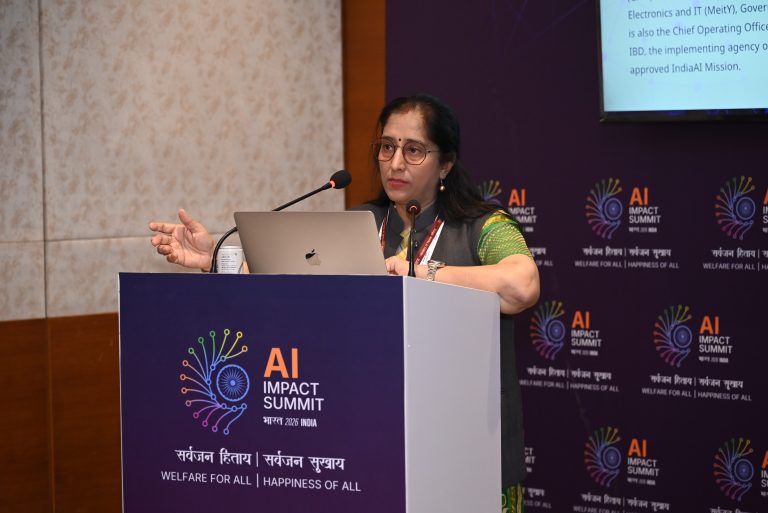
Kavita Bhatia – Scientist G and Chief Operating Officer of the IndiaAI Mission at the Ministry of Electronics and Information Technology, set the context for the discussion with her keynote. She emphasised that when AI is integrated into DPI, it does not operate as a separate layer but becomes embedded within the infrastructure itself. In her remarks, she noted that bias, opacity, and accountability failures do not affect a single service; they can extend across interconnected systems. Drawing on India’s experience with Aadhaar, UPI, and the India Stack, she underscored that trust is built incrementally through cycles of prototyping and iteration rather than through large, single deployments.
Sandboxes as Governance Infrastructure
Morine Amutorine – Africa Sandboxes Forum Lead at the Datasphere Initiative, offered a grounded definition: “Think of sandboxes as controlled learning environments designed for structured experimentation, under defined governance frameworks, built-in safeguards, and timeframes.” She further highlighted that sandboxes are not defined by testing alone, but by how participation is structured. In her intervention, she stressed the importance of bringing civil society, community groups, and academia into the process alongside governments and service providers, enabling shared learning and accountability. She outlined three central functions: testing on real data prior to deployment, identifying algorithmic bias while issues remain correctable, and creating feedback loops that allow experimentation to shape policy design.
Dr. Verena Kontschieder – Co-CEO of Opendata.ch and Program Lead for Prototype Fund Switzerland, situated this within a broader structural challenge. She observed that institutional systems are often geared toward launching new technologies rather than critically examining their long-term societal impacts. “AI all of a sudden becomes so foundational and so fundamental to how we work and designs us as a society. The central question must be: how are we not just creating models, but actually considering societal considerations?” In her remarks, she suggested that sandboxes can help bridge this gap, provided they operate within real infrastructure conditions rather than abstract environments. She also underscored the importance of involving civil society and affected communities to surface potential systemic harms before they scale.

Three Countries, Three Approaches
Tanzania, represented by Dr. Nkundwe Moses Mwasaga – Director General of the ICT Commission, outlined the country’s ongoing development of its Digital Public Infrastructure. He described the Jamii Stack as comprising a national digital ID, an interoperability layer connecting over 800 government systems, and an instant payments platform, with sandbox mechanisms integrated to ensure alignment with new data protection legislation from the outset. He framed this architecture as foundational to formalising economic participation, stating, “Our goal is to convert the informal economy to be formal. By providing digital ID and making all systems talk to each other, we create limitless opportunity.”
Nepal, represented by Adesh Khadka – Joint Secretary at the Ministry of Communication and Information Technology, reflected on a different phase of digital maturity. National ID systems and private-sector digital payments are already operational, and the next priority is building a data exchange platform while operationalising Nepal’s AI policy, which explicitly provides for sandboxing. As he noted, “There are always two parts of government. One promotes innovation; the other safeguards trust. Walking that balance is the work.”
A key intervention came from Alexandru Oprunenco – Team Leader for Innovation and Digital at UNDP Asia-Pacific. He noted that governments often struggle to clearly articulate the specific issue they aim to address, and that proposed solutions can reflect internal administrative priorities rather than citizen-facing needs. “We had a conversation about a super app. My question was: what is the feedback from users? The response was: ‘our police officers are very happy.’ That illustrates the gap.” He proposed a foundational framework: Why is the intervention needed? What specific policy problem is being addressed? For whom is it designed? And how will it reshape institutional relationships? Dr. Kontschieder extended this further by asking what unintended problems may arise and who may bear the greatest harm.

Report Launch: Sandboxes for DPI
The session marked the formal launch of Sandboxes for DPI: Co-creating the Blocks of Digital Trust, the Datasphere Initiative’s first systematic effort to establish a global framework for DPI sandboxes. In a video address, Lorrayne Porciuncula – Co-founder and Executive Director of the Datasphere Initiative, outlined the report’s contributions: the first formal definition of DPI sandboxes across identity, payments, and data exchange; a revised taxonomy of regulatory, operational, and hybrid models; and a global inventory of 16 DPI sandbox initiatives, from India’s Aadhaar sandbox to the EU Digital Identity Wallet.
Positioning sandboxes as more than technical instruments, she emphasised their role in building public confidence: “Sandboxes can be what we call laboratories of trust. When done responsibly, they can serve not only as technical testing grounds, but as levers for trust.”
The report is available at thedatasphere.org/datasphere-publish/sandboxes-for-dpi/
From Conversation to Action
Across the session, speakers emphasised that responsible AI-DPI integration requires clearly defined problems, a citizen-centred purpose. They highlighted the importance of multi-stakeholder participation, and institutional conditions that treat failure as a source of learning. The overall consensus was that structured experimentation is a preliminary step that is central to governance.
Several concrete commitments emerged. The Datasphere Initiative will develop a practical toolkit for DPI sandboxes throughout 2026 and launch a dedicated sandbox track at the Datasphere Sandbox Summer School in Lisbon. The Africa Sandboxes Forum is offering direct coaching to governments exploring sandbox approaches. India’s AI Governance Framework remains open for contributions on risk assessment methodologies.
The session concluded with five themes: Experiment, People, Sustainable, Building Citizen Confidence, Trust.
Watch the “AI-DPI Experimentation and the Role of Sandboxes” event
Link to the YouTube Video